
Picture this. It’s a family gathering, and a well-meaning relative leans in for a big, squeezy hug. You see your child’s shoulders tense up, their smile becomes a tight line, and they subtly try to lean away. But you give them ‘the look’… the one that says, “Just be polite.” So, they endure the hug, their body rigid, until they can finally squirm away. Later, you might find them irritable or withdrawn, the unspoken discomfort from that moment still lingering.
Or maybe it’s a playdate, and another child snatches a favourite toy. Your child freezes, their face a storm of conflicting emotions. They want to grab it back, to shout, “That’s mine!” but they don’t. The moment passes, and a quiet resentment sets in. As parents and carers, we see these small moments and often dismiss them as just part of being a kid. But they are more than that. They are moments where a child is learning… or not learning… one of life’s most critical skills: how to set a personal boundary.
Teaching a child to say what they need, to protect their personal space, and to voice their discomfort is not about teaching them to be difficult or rude. It’s about giving them the tools for self-respect and healthy relationships. It’s a skill that builds confidence and emotional resilience. And at Paws 4 Change, we’ve discovered that one of the best teachers of this complex human skill doesn’t use words at all. They have four paws, a wet nose, and an unshakeable understanding of consent.
This is a light-hearted but powerful look at how our canine friends can help our kids find their voice, one gentle “no” at a time.
What Are Boundaries, Anyway? (And Why Are They So Hard for Kids?)
In the simplest terms, a personal boundary is the invisible line we draw around ourselves that separates us from others. It defines what feels comfortable and what doesn’t… physically, emotionally, and mentally. It’s our personal “rule book” for how we want to be treated. For adults, this might look like saying no to extra work when you’re burnt out, or telling a friend you don’t have the emotional energy for a heavy conversation.
For kids, it’s much more immediate. It’s about:
- Not wanting to be tickled.
- Needing quiet time after a noisy day at school.
- Not wanting to share a specific, special toy.
- Not wanting to give a hug or kiss, even to a beloved grandparent.
These are not acts of defiance; they are expressions of an internal need. So why is it so hard for children to voice them? From a very young age, kids are often praised for being compliant, for sharing nicely, and for “being good.” They are taught, implicitly and explicitly, that the comfort of adults is more important than their own. They fear disappointing the people they love, getting into trouble, or being seen as “naughty.” This ‘good kid’ conditioning runs deep, teaching them that their value lies in their ability to please others, often at the expense of their own comfort.
Furthermore, a child’s brain is still developing. The prefrontal cortex, responsible for impulse control and long-term thinking, is not fully formed. This means that in a socially stressful moment, the more primitive, emotional parts of the brain take over. The fear of a beloved adult’s disapproval can feel like a genuine threat to a child’s sense of safety and connection, making it neurologically difficult to go against the grain. They often simply lack the vocabulary to articulate their feelings. A child might not be able to say, “I am feeling overstimulated and need some personal space.” Instead, that feeling comes out as a tantrum, a withdrawal into silence, or a seemingly random burst of anger. They have the feeling, but not the words. They know something feels wrong, but they don’t feel they have the right to stop it.
The Canine Consent Masterclass
This is where a dog becomes the perfect, non-judgmental teacher. Dogs are absolute masters of boundaries. They don’t worry about hurting someone’s feelings or being impolite. They live in the moment, and they are experts at communicating their needs clearly and effectively. A dog’s world is a constant negotiation of consent, and they give and withdraw it with beautiful simplicity.
In our canine-assisted learning programs, we turn this into a practical lesson. We teach children to become “dog detectives,” learning to read the subtle language of consent. We show them that before you pat a dog, you must first ask for permission. And the dog will always give you an honest answer.
What a Dog’s “Yes” Looks Like:
- A soft, relaxed body and face.
- Leaning into your touch.
- A gentle, sweeping tail wag.
- Nudging your hand for more pats.
What a Dog’s “No, Thank You” Looks Like:
- Turning their head away from you.
- Leaning or stepping away.
- A stiff, rigid body.
- Showing the whites of their eyes (often called “whale eye”).
- Licking their lips when there’s no food around.
- A sudden yawn outside of being tired.
A low growl is not a sign of a “bad dog.” It is a clear, articulate sentence that says, “I have asked you politely to stop, and you are not listening. I am now telling you more clearly.” It is a perfectly valid and important boundary.
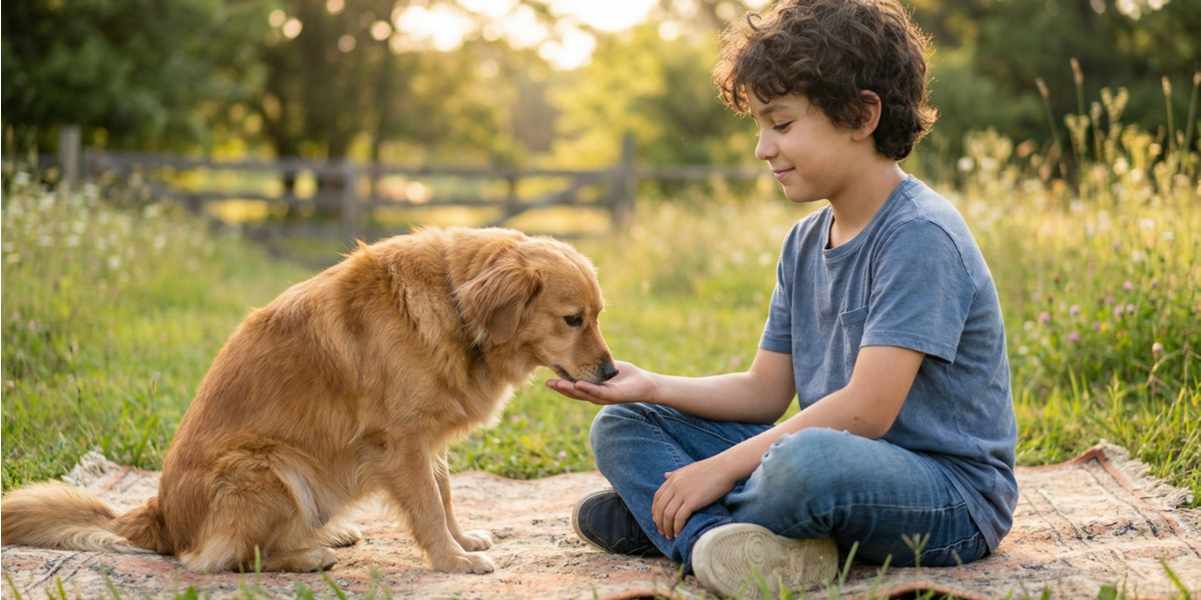
When we guide a child to offer the back of their hand and wait for the dog to lean in, we are teaching them the physical dance of asking for consent. When we point out, “See how Buddy turned his head away? He’s saying ‘no thanks’ to a pat right now. Let’s give him some space,” we are teaching the child to listen to and respect that answer. This simple, repeated act of observing and honouring a dog’s boundaries provides a powerful, real-time education in consent that no lecture or book could ever replicate.
From Reading Barks to Finding Their Voice
The magic happens when a child moves from simply observing the dog to understanding the feeling behind the action. This is the bridge from reading a dog’s boundaries to recognising their own.
1. It Normalises the Act of Saying “No.”
When our therapy dog, Charlie, decides he’s had enough pats and walks away, he isn’t being mean or rude. He’s just meeting his own needs. The interaction isn’t personal; it’s informational. For a child who is a natural people-pleaser, this is a revelation. They learn that setting a boundary isn’t an act of rejection. It’s a healthy, normal part of any relationship. Charlie still likes the child, he just doesn’t want a pat in that moment. This simple observation detaches the act of saying “no” from the fear of social punishment.
2. It Builds Empathy and Perspective-Taking.
To respect a dog’s boundary, a child must first recognise that the dog is a separate being with its own feelings and limits. They have to step outside of their own desire (to pat the fluffy dog) and consider the dog’s desire. When a child says, “I’ll wait until he’s ready,” they are practising empathy. This ability to see things from another’s perspective is the foundation of all healthy relationships.
3. It Gives Them a Script.
Once a child can identify a boundary in a dog, we can give them the words to apply it to themselves. A facilitator might say, “Remember how Buddy yawned when things got a bit loud? That was his way of saying he felt a bit overwhelmed. When you feel like that, you could say, ‘I need some quiet time, please.’”
Suddenly, the confusing, overwhelming feeling inside them has a name and a script. The internal chaos gets an external voice. We are connecting the dog’s experience directly to their own, empowering them to articulate their needs in a calm and clear way.
Busting the Myths: Won’t My Child Become Rude or Selfish?
This is a common and understandable fear for parents. We want our children to be kind, considerate, and well-liked. The worry is that teaching them to say “no” will turn them into demanding or uncooperative little tyrants. But the opposite is true. Teaching boundaries is not about teaching selfishness; it’s about teaching self-respect. And a child who respects themselves is far more capable of genuinely respecting others.
Children who are forced to constantly ignore their own needs don’t learn true kindness. They learn resentment and compliance. They may act polite on the surface, but underneath, they are learning that their feelings don’t matter. This can lead to passive-aggressive behaviour, people-pleasing that leads to burnout, or an eventual explosion of frustration.
In contrast, a child who is empowered to set a boundary learns that their needs are valid. They also learn that other people’s needs are valid. The same process of learning to respect a dog’s “no” teaches them to respect a friend’s “no” on the playground. They learn that relationships are a two-way street, a negotiation of needs. This is the foundation of authentic kindness, not the forced politeness that comes from fear.
Practical Strategies: The Dog as a Boundary Coach
You don’t need a certified therapy dog to start putting these principles into practice. You can become a body language detective with your child today.
- Practise the “Pat Test.” Make it a house rule that no one just pats the dog. You must always offer your hand first and let the dog make the choice to engage. Narrate it out loud: “I’m going to ask Rover if he’d like a pat. Oh, look, he’s leaning in! That’s a yes.” Or, “Rover turned his head away. That’s a no for now. I’ll try again later.”
- Appoint Your Child as the Dog’s Advocate. This is a wonderfully empowering technique. Encourage your child to protect the dog’s boundaries. If another person is being too rough or is bothering the dog while it’s sleeping, you can say to your child, “It looks like the dog isn’t enjoying that. Can you be his voice and ask them to please stop?” For many kids, advocating for someone else is a much safer first step than advocating for themselves. It lets them practise using boundary-setting language from a position of strength and care.
- “Stop” Means the Game is Over. When playing fetch or tug, the moment the dog disengages… by dropping the toy and walking away… the game stops. This teaches a powerful life lesson: when one person wants to end an interaction, the interaction ends. It reinforces that “stop” is a complete sentence that must be respected.
- Use “I Feel…” Statements, Inspired by the Dog. Help your child connect their feelings to the dog’s behaviour. “When you get all tense and quiet like that, it reminds me of how Buddy looks just before he growls. It tells me you’re feeling really uncomfortable. Is that right?”
The Long-Term Gift: From the Playground to the Boardroom
The skills a child learns by negotiating with a furry friend don’t stay in the home or the therapy room. They are foundational life skills that will serve them for decades to come. A child who can confidently and kindly say “no, thank you” to an unwanted hug is building the muscle they will need to…
- Navigate playground politics: They will be better equipped to say, “I don’t like that game,” or, “Please don’t push.” This can be a powerful tool in preventing bullying.
- Form healthier friendships: They will be drawn to friends who respect their boundaries and will be better at respecting the boundaries of others.
- Handle peer pressure in their teenage years: The ability to say “no” to things that feel wrong or unsafe is a skill that is forged in these small, early moments.
- Build healthy romantic relationships as adults: A person who understands consent and has a strong sense of their own boundaries is more likely to create partnerships based on mutual respect.
- Succeed in the workplace: They will be more likely to avoid burnout by setting limits on their workload and be more confident in negotiating for what they need.
Learning to set boundaries is a journey, not a destination. It requires practice, patience, and the safety to get it wrong sometimes. By using the simple, honest wisdom of our dogs, we can give our children a living, breathing model of what healthy self-respect looks like. We teach them that their feelings are valid, that their “no” has power, and that they have the right to say what they need. It’s a lesson that begins with a gentle bark and builds a lifetime of confidence.